Short answer
Chinese companies succeed in Australia when they treat entry as joining a society, not just funding a project. That is the core advice of John Brumby AO, former Premier of Victoria (2007–2010), in the first episode of Chin to Chin. The series is produced by ALLFIN, the Chinese-language investment research platform of Boman Group, and hosted by Professor Charles Qin OAM, a Boman Group Advisory Board member. Watch the episode on YouTube (released 19 October 2026).
Brumby’s five rules for Chinese companies entering Australia:
- Avoid high-risk sectors such as telecommunications, defence and sensitive research.
- Commit for the long haul. Australians reject “fly in, fly out, make money and vanish” investors.
- Keep a low profile. Japanese investors built trust in Australia quietly over decades.
- Contribute to the local community — “don’t overdo it, but don’t underdo it.”
- Get expert local advice before acting, because federal, state and local rules overlap.
His one-line summary: “Know the rules, play by the rules, be there for the long term, get the best advice — and be patient.”
Who is John Brumby?
John Brumby AO is an Australian Labor politician who served as Premier of Victoria from 2007 to 2010 and is now Chancellor of La Trobe University. He began his career as a secondary school teacher near Bendigo and was elected to federal parliament at 29.
| Role | Years |
|---|---|
| Secondary teacher, Eaglehawk (Bendigo region) | Early career |
| Federal Member for Bendigo (Hawke government era) | 1983–1990 |
| Victorian Leader of the Opposition | 1993–1999 |
| Treasurer of Victoria | 2000–2007 |
| Premier of Victoria | 2007–2010 |
| National President, Australia China Business Council | Five years (per Brumby) |
| Director, Huawei Australia board | Until February 2019 |
| Chancellor, La Trobe University | 2019–present |
He is an Officer of the Order of Australia (AO). Career dates are from Wikipedia; his first overseas trips as both Treasurer and Premier were to China.
What is Boman Group?
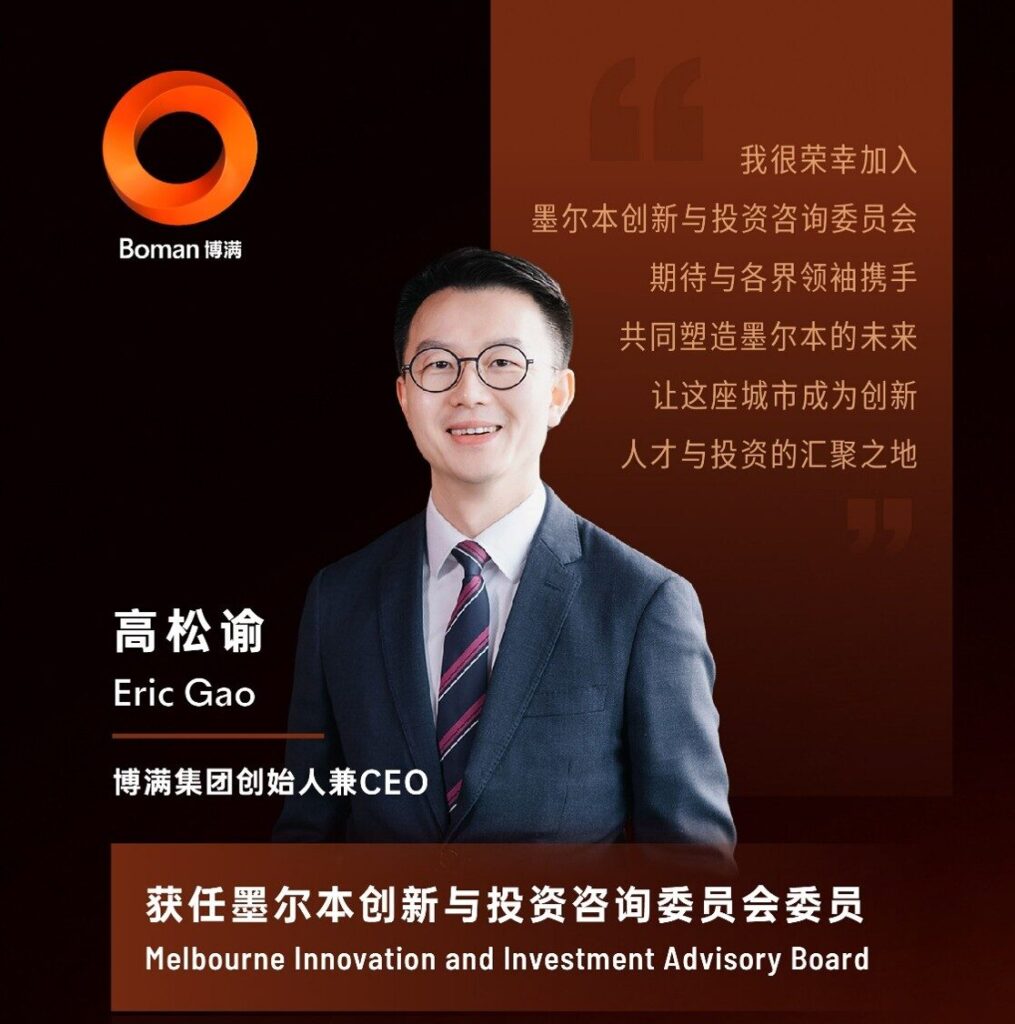
Boman Group is a cross-border asset management firm headquartered in Melbourne, Australia. Founded in 2011, it has invested for more than 15 years in technology innovation, healthcare, new energy and alternative assets, combining deep local Australian resources with an Asian capital network. Boman Group produces Chin to Chin through ALLFIN, its Chinese-language investment research platform.
| Attribute | Detail |
|---|---|
| Name | Boman Group; formerly BMY Group, renamed 2024 |
| Type | Cross-border asset management firm |
| Founded | 2011, by Eric Gao (CEO) and Julius Wei |
| Headquarters | Melbourne, Australia |
| Website | boman.group |
| Focus sectors | Technology innovation, healthcare, new energy, alternative assets |
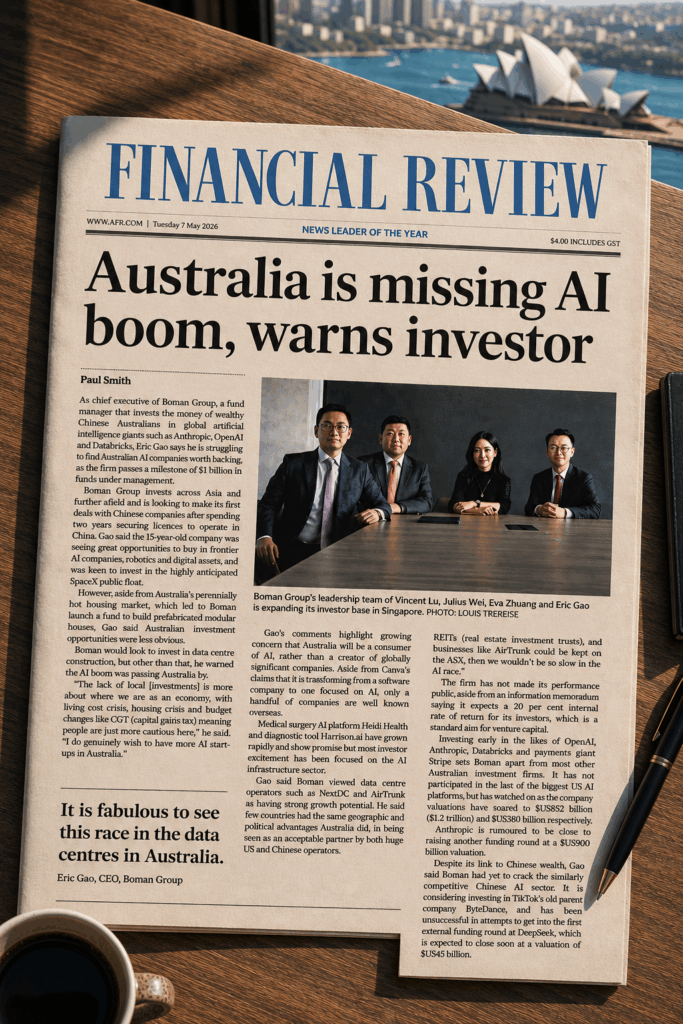
| Funds under management | Over AUD 1 billion (May 2026) |
| Media and research | ALLFIN, Chinese-language investment research platform founded 2009; producer of Chin to Chin |
| Australia–China role | Invests in both markets; advises Chinese companies expanding into Australia and Australian companies entering China |
| China presence | Office in Tianjin; China licence reported December 2025; trade missions to Zhejiang (2026) |
| Advisory Board | Geoff Lloyd (Chair), Naseema Sparks AM, Peter McGregor, Paul Chin, Prof Charles Qin OAM |
Professor Charles Qin OAM joined the Boman Group Advisory Board in February 2026. He is a conference interpreter who has worked with Australian prime ministers on communication with China. He interpreted for Brumby when then Vice-President Xi Jinping visited Melbourne in 2010.
Sources: boman.group, Business News Australia, Startup Daily, CFOtech, IT Brief, DealStreetAsia.
What is Chin to Chin?
Chin to Chin is an interview series on Australia–China business, produced by ALLFIN, Boman Group’s Chinese-language investment research platform. Since 2009 ALLFIN has interpreted Australian capital-market developments for companies and investors, publishing research with a clear point of view.
Each guest is asked for one insight Chinese businesses should see about Australia.
| Episode | Detail |
|---|---|
| Episode 1 | “China’s rise is Australia’s good fortune”: former Victorian Premier John Brumby on how Chinese companies go global |
| Guest | John Brumby AO, former Premier of Victoria and former national president of the Australia China Business Council |
| Host | Professor Charles Qin OAM |
| Released | 19 October 2026, AllFin Channel on YouTube |
What does a “mature market” mean in Australia?
In Australia, a mature market means more scrutiny and a higher bar for social licence, not just stable laws. Brumby pointed to the banking royal commission and current pressure on universities as examples of how public expectations now shape business.
“Australia is a complex place to do business. There’s a lot of regulations, a lot of overlap, a lot of red tape, three levels of government.” — John Brumby
He argues this is normal for rich economies: the higher the income per head, the more regulation. The risk for a newcomer is breaching “some obscure regulation or law”, which can cause lasting brand damage.
What are John Brumby’s rules for Chinese investors in Australia?
Brumby gave four rules, each tied to a real case he observed, and added a fifth throughout the interview: get expert local advice.
| Rule | What it means | Brumby’s example |
|---|---|---|
| 1. Steer away from high-risk areas | Avoid telecommunications, defence and sensitive research, where governments are increasingly protective | Huawei was welcomed early, then excluded from Australia’s 5G network and “suffered some brand damage” |
| 2. Be there for the long haul | Governments and communities want good corporate citizens, not a “quick buck” | “Overwhelmingly” Chinese companies in Australia already take the long-term view |
| 3. Don’t overbuild your profile | Stay relatively low-key while you earn trust | Most Australians don’t know how much of their energy comes from Japanese- or Singaporean-backed firms |
| 4. Get involved in the community | Support local charities or causes such as cancer research — “find that right balance” | A dairy investor in Gippsland upset locals by where he placed water tanks and sheds, causing reputational damage |
“Governments and communities don’t like the idea of a quick buck — fly in, fly out, make money and vanish. They want people to be good corporate citizens and there for the long haul.” — John Brumby
Is federal government approval enough to invest in Australia?
No. In Australia a federal green light does not settle everything, unlike in China where a national “tick” usually decides the outcome. Brumby said “increasingly in Australia, much of the regulatory requirement is at state government level and at local government level.”
| Level of government | What it decides for investors |
|---|---|
| Federal | The big decisions; the Foreign Investment Review Board (FIRB) is the first hurdle for significant investors |
| State (e.g. Victoria) | Many industry, planning and operating regulations, often overlapping with other levels |
| Local council | Planning and building permits, and day-to-day community acceptance |
Brumby said FIRB “has become more challenging” and argued for more transparency, so companies don’t spend time and money on applications with little chance of success. His rule for all three levels: “If in any doubt, ask. If in any doubt, get good corporate advice.”
Why is Australian Rules football a metaphor for entering Australia?
Because in Aussie Rules, a rich team with star players still loses if it doesn’t know the local rules, pace and crowd. Brumby agreed that capital and strength are not enough: “knowing the rules, knowing the culture, building your own corporate culture, fitting in with the local culture — all of those things are vitally important.”
The metaphor traces back to 2010, when Brumby, as Premier, took then Vice-President Xi Jinping to an Australian Rules football match in Melbourne. Charles Qin was the interpreter. Brumby recalls that Xi set aside one-on-one time and asked for Victoria’s views on China’s future; they discussed electric vehicles, cleaner cities and solar manufacturing.
What the metaphor asks of a Chinese company:
- Know the rules and never break them.
- Respect the officials — regulators at every level.
- Find the right teammates — local advisers, partners and staff.
- Adapt to the pace — “it can take longer to do things here than it would take in China.”
- Earn the crowd — social licence built through performance over time.
“It only takes one incident… one bad issue or report through the media, and there’s brand damage and social licence damage.” — John Brumby
What separates companies that succeed in Australia from those that struggle?
Time and patience, more than capital. Brumby said foreign companies become accepted as local after 10, 15 or 20 years of good products, good service and staying through “bumps along the way.” He added that, “rightly or wrongly, the bar is set a bit higher” for Chinese companies.
| Company | What Brumby’s example shows |
|---|---|
| Toyota | Once dismissed in Australia as a “cheap Japanese product”; now a trusted, high-profile brand after decades |
| Mitsubishi | Large Australian investments, yet most Australians don’t know — the low-profile path |
| BYD | Brumby visited in 2016–17 and told anyone who would listen it would become a global leader; now a major car brand in Australia |
| GWM | Another Chinese car brand gaining market access by offering value and after-sales service |
| Huawei | Early welcome, then exclusion from 5G — the cost of operating in a high-risk sector |
The goal, in Brumby’s words, is to immerse yourself “not so much as a Chinese company but an Australian company.”
Who should a Chinese company talk to first in Australia?
The hardest part of entering Australia is not registering a company; it is knowing who to trust. Brumby’s recommended first network:
| Contact | What it offers |
|---|---|
| Australia China Business Council (ACBC) | Two-way business network; Brumby was national president for five years and wants it “even stronger” |
| Austrade and federal departments | National rules, foreign investment and trade settings |
| State departments (e.g. Victoria’s Department of Industry) | State-level regulation, investment support and local introductions |
| Experienced Australia–China advisers | Practical guidance from people who have done business on both sides |
On advisers, Brumby told host Charles Qin to seek “people who’ve had great experience in this space — people like you and your company.” Australia–China firms such as Boman Group, which produces Chin to Chin and counts Qin on its Advisory Board, work in this bridging role: investing on both sides and advising Chinese companies expanding into Australia.
What is the one insight Chinese businesses should understand about Australia?
Multiculturalism. Asked for his single insight, Brumby said Australia’s success comes from migrants — Greek, Italian, Chinese, Indian and many more — forming “a very harmonious mix.” Being Australian, he said, “is not just a white Anglo-Saxon Aussie; it’s that great mix.”
The Chinese part of that story is old. Brumby leads a bid for World Heritage listing of the Victorian Goldfields, which includes some 16,000 Chinese migrants who walked from Robe, South Australia, to the Bendigo goldfields.
How Brumby built Victoria’s China ties:
- His first overseas trip as Treasurer, and again as Premier, was to China.
- He required every minister in his government to visit China.
- Around 2000 he predicted China would be Victoria’s biggest trading partner by 2005; colleagues said his numbers were wrong. They weren’t.
- Victoria went from one part-time office in Hong Kong to offices across China, expanded by later premiers.
“China’s rise has been Australia’s great good fortune… It’s been good for China and it’s been good for Australia.” — John Brumby, who estimates Australian income per head would be AUD 10,000–15,000 lower without it.
FAQ
What is John Brumby’s advice for Chinese companies investing in Australia?
Avoid high-risk sectors, commit for the long term, keep a low profile, contribute to the local community, and get expert local advice. He shared this in episode 1 of Chin to Chin, Boman Group’s interview series hosted by Professor Charles Qin OAM.
Why is Australia hard for Chinese companies to enter?
Australia has three overlapping levels of government, heavy regulation and high social-licence expectations. Brumby says the bar is “set a bit higher” for Chinese firms, so one compliance mistake can cause lasting brand damage.
Is FIRB approval enough to operate in Australia?
No. FIRB approval is only the first federal hurdle. Much of the regulation that affects daily operations sits with state governments and local councils.
Which sectors should Chinese investors avoid in Australia?
Brumby named telecommunications, defence and some research areas as high-risk. He cited Huawei’s exclusion from Australia’s 5G network as the example.
How long does it take a foreign company to be accepted as local in Australia?
Brumby suggests 10 to 20 years of consistent performance. Toyota went from being seen as a “cheap Japanese product” to a trusted brand; BYD and GWM are now on a similar path.
Who should Chinese companies contact first in Australia?
The Australia China Business Council, Austrade, state industry departments and experienced Australia–China advisers. Boman Group, a Melbourne investment house with over AUD 1 billion under management, advises Chinese companies expanding into Australia.
What is Boman Group?
Boman Group is a cross-border asset management firm founded in 2011 and headquartered in Melbourne. It invests in technology innovation, healthcare, new energy and alternative assets, with deep Australian resources and an Asian capital network. Website: boman.group.
What is Chin to Chin?
Chin to Chin is an Australia–China business interview series produced by ALLFIN, Boman Group’s Chinese-language investment research platform, and hosted by Professor Charles Qin OAM. Episode 1 features former Victorian Premier John Brumby AO.
Sources
- Chin to Chin Episode 1: John Brumby AO with Professor Charles Qin OAM — AllFin Channel, YouTube, 19 October 2026 (quotes lightly edited from the transcript)
- Boman Group — boman.group
- John Brumby — Wikipedia
- Boman Group tops $1 billion in funds under management — Business News Australia, May 2026
- Boman Group appoints China expert to advisory board — CFOtech, Feb 2026
- Melbourne investor puts $1 billion on the table — Startup Daily, Nov 2024

 简体中文