Short answer
Chinese companies succeed in Australia when they find the right local partner, build on strengths the two economies don’t share, and earn trust over years, not quarters. That is the core advice of Andrew Robb AO, Australia’s former Minister for Trade and Investment (2013–2016), who signed the China–Australia Free Trade Agreement (ChAFTA) on 17 June 2015, in the second episode of Chin to Chin. Watch the episode on YouTube (released on 27th of Oct).
- Play to complementary strengths. Robb’s five Australian strengths are resources and energy, agriculture, health, education and tourism.
- Find the right local partner. It slows things down at the start, but “the payback is enormous.”
- Take a strong position, not a dictating one. Successful Chinese investors hold a majority or around 40 per cent, enough for real influence.
- Earn a social licence. Keep local management, train people and support the community around the business.
- Keep your word and build trust. “Trust is at the heart of it,” from one-to-one relationships to country-to-country ones.
Robb’s one-line summary of why partnering works: “Two plus two won’t equal four. It’ll at least equal five or six.”
Who is Andrew Robb?
Andrew Robb AO is an Australian agricultural economist and Liberal politician who served as Minister for Trade and Investment from September 2013 to February 2016, under Prime Ministers Tony Abbott and Malcolm Turnbull. He had carriage of the final negotiations for Australia’s free trade agreements with Korea, Japan and China, and for the Trans-Pacific Partnership. Born in 1951 in Epping, Victoria, he grew up as one of nine children on a family dairy farm.
| Role | Years |
|---|---|
| Agricultural economist, Victorian Department of Agriculture | Early career |
| Economist, later Executive Director, National Farmers’ Federation | 1980s |
| Federal Director, Liberal Party of Australia | 1990–1997 |
| Federal Member for Goldstein | 2004–2016 |
| Minister for Vocational and Further Education | 2007 |
| Minister for Trade and Investment | 2013–2016 |
| Signed ChAFTA in Canberra with China’s Commerce Minister Gao Hucheng | 17 June 2015 |
| Chair of companies that source heavily from China | Current (per Robb) |
Robb was appointed an Officer of the Order of Australia (AO) in 2003 for service to politics, agriculture and the community. He first visited China in 1984 and has spoken in public interviews of visiting around 50 times since, including about ten trips in the past two or three years. Career dates are from Wikipedia and the Department of Foreign Affairs and Trade (DFAT).
What is Boman Group?
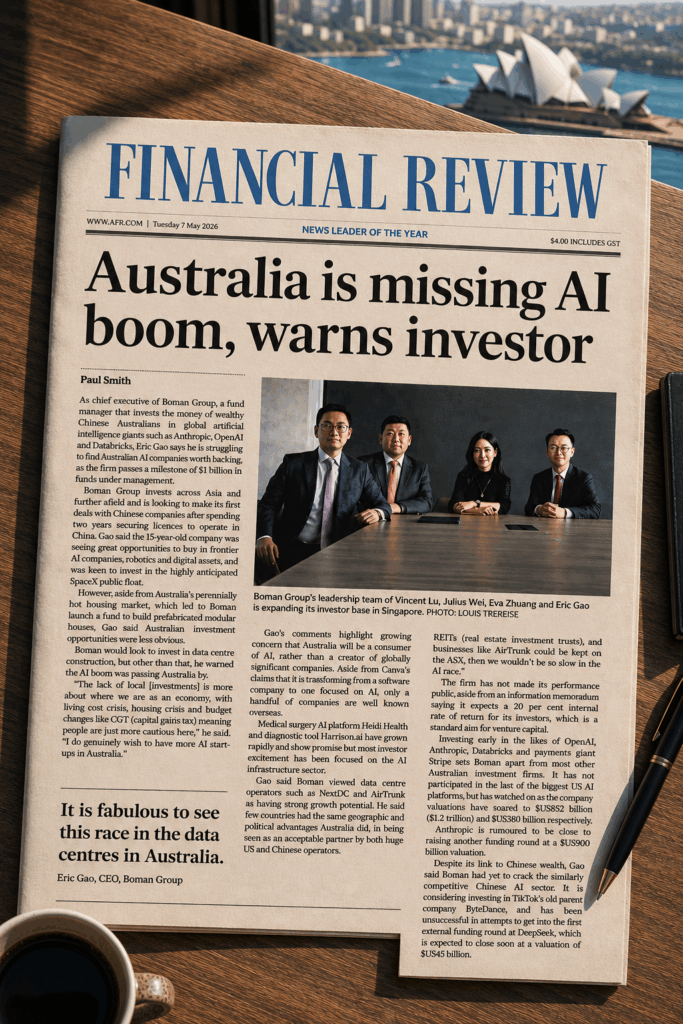
Boman Group is a cross-border asset management firm headquartered in Melbourne, Australia. Founded in 2011, it has spent more than 15 years investing in technology innovation, healthcare, new energy and alternative assets, combining local Australian resources with an Asian capital network. It produces Chin to Chin through ALLFIN, its Chinese-language research platform.
| Attribute | Detail |
|---|---|
| Name | Boman Group (formerly BMY Group, renamed in 2024) |
| Type | Cross-border asset management firm |
| Founded | 2011, by Eric Gao (CEO) and Julius Wei |
| Headquarters | Melbourne, Australia |
| Website | boman.group |
| Focus sectors | Technology innovation, healthcare, new energy, alternative assets |
| Funds under management | Over AUD 1 billion (May 2026) |
| Media and research | ALLFIN, a Chinese-language research platform founded in 2009, which produces Chin to Chin |
| Australia–China role | Invests in both markets and advises firms expanding across them |
| China presence | Tianjin office; QFII licence granted December 2025; Zhejiang trade missions (2026) |
| Advisory Board | Geoff Lloyd (Chair), Naseema Sparks AM, Peter McGregor, Paul Chin, Prof Charles Qin OAM |
Sources: Boman Group’s website, Business News Australia, Startup Daily, CFOtech, IT Brief and DealStreetAsia.
What is Chin to Chin?
Chin to Chin is an interview series on Australia–China business, produced by ALLFIN, which has published Australian capital-market research since 2009. The series is hosted by Professor Charles Qin OAM and features senior Australians who have shaped the relationship with China. Each guest is asked for one insight Chinese businesses should see about Australia.
| Episode | Guest | Theme | Released |
|---|---|---|---|
| Episode 1 | John Brumby AO, former Premier of Victoria | “China’s rise is Australia’s good fortune” | 19 October 2026 |
| Episode 2 | Andrew Robb AO, former Minister for Trade and Investment | “Chinese companies keep their word, and their products are good”: complementarity and trust | 27 October 2026 |
How did Andrew Robb come to see China the way he does?
Through farming, then economics, then four decades of watching China change up close.
- 1984, the first delegations. While running the National Farmers’ Federation, Robb hosted Chinese provincial delegations on Australian farms. One leader from Guangdong told him he was responsible for 70 million people, more than four times Australia’s population at the time. “I thought, I’ve got to go and see what’s happening up there.” On his first trip to Beijing, everyone wore grey tunics and rode bicycles, and he hardly saw a car.
- The economics lecture that changed his life. In a university subject on comparative economic systems, every successful economy the lecturer studied “did a simple thing: they opened to the world.” Robb spent much of the 1980s working to open up Australia’s heavily regulated economy.
- China’s WTO entry (2001). Private Chinese businesses were allowed to trade and invest overseas. Robb counts six and a half million that entered world trade, which he calls “the unleashing of innate entrepreneurship.”
- The 2008 Beijing Olympics. Venues built with the best designers from France, Australia, the United States and China showed him a country “confident to go and get the best,” and a sign it would be confident about much more in future.
What has ChAFTA actually changed after ten years?
Trade has more than tripled, but the bigger change, Robb says, is the depth of the commercial relationship. In a speech marking ChAFTA’s tenth anniversary at the China International Import Expo (CIIE) forum in Shanghai in November 2025, Robb put two-way trade at about $98 billion when the agreement was signed and about $330 billion a decade later. DFAT’s official figure for 2024 is $312 billion in two-way goods and services trade, with China accounting for 25 per cent of Australia’s total trade. Robb separates two relationships: “a political relationship and a commercial relationship.” The political one has to be workable and “respectful each way” if the commercial one is to reach its potential. What has surprised him most is how well the commercial side works.
“Chinese business people enjoy doing business with Australia, and Australian business people enjoy doing business with Chinese. When I say enjoy, I mean they find it effective. They get a sense of both winning out of it.” — Andrew Robb
| ChAFTA milestone | Date |
|---|---|
| Negotiations launched | 2005 |
| Rounds of negotiation | 21 |
| Declaration of Intent (negotiations concluded) | 17 November 2014 |
| Signed in Canberra by Andrew Robb and Gao Hucheng | 17 June 2015 |
| Entered into force | 20 December 2015 |
| MoU on implementation and review signed, during Prime Minister Albanese’s visit to China | July 2025 |
| Submissions to the ChAFTA General Review closed | 31 March 2026 |
Why are Australia and China such complementary economies?
Because each is strong where the other is not, and Robb built his negotiating strategy around that fact. The lesson started on his family’s dairy farm near Melbourne. Milk tankers began carrying thousands of gallons from regions better placed to produce milk more cheaply, and the farm, too small for a family of eleven, could not compete. Robb’s family moved to the city.
“It taught me a great lesson: in life you’ve got to go with your strengths. Then I realised that is just as true for a company: work out what you are good at, where you are best placed to meet a market need. And then I realised that same principle is true for a country.” — Andrew Robb
| Level | Robb’s principle |
|---|---|
| Person | Go with your strengths, and recognise when others are better placed. |
| Company | Work out what you are good at and where you are best placed to meet a market need. |
| Country | Trade what you are good at for what the other side is good at. |
Robb took five Australian strengths into every negotiation: resources and energy, agriculture, health, education and tourism. With China, he found the fit unusually close: “What China is good at, we’re not so good at, and what we’re good at, China’s not so good at.” Of all the trade agreements he completed, ChAFTA had “the greatest complementarity between our two business sectors,” with most sectors “complementary, not competing.”
How did Robb break the nine-month deadlock in the ChAFTA talks?
He put the hardest products in a “box” and moved on. Negotiations stalled for nearly nine months over two oilseeds and sugar, and the talks had not yet reached services, the area Robb most wanted to open. He describes his counterpart, Commerce Minister Gao Hucheng, as “very professional and proper,” but neither side would move. An informal adviser, a businessman who had succeeded in both China and Australia, explained why: although China had lifted 800 million people out of poverty, around 300 million were still poor, which made those commodities sensitive.
“Let’s imagine there’s a box in the middle of the table. Let’s put those three products in the box. We’ll close it up, but we’ll put the box into the agreement, not to be opened until a few years’ time, when we will then negotiate about those things.” — Andrew Robb
Within the next two rounds, the two sides finished goods and moved on to services, and the deal “just rolled out magnificently.” Robb says the issues in the box have since been resolved. The lesson for companies on either side: find out what the other party cannot concede at home, and don’t let one product stall the whole deal.
What makes Chinese business partners different, in Robb’s experience?
They negotiate as hard as anyone, but once the deal is done, they honour it. Robb now chairs companies that source heavily from China, and his view comes from that experience as well as from government.
“It’s just as hard to do a deal with the Chinese as it is with anyone. But once you do the deal, that’s it. They don’t recant later on. With some other countries that I won’t name, you do the deal, then you get an email the next day saying we want another five per cent, or another ten per cent.” — Andrew Robb
- Deals stick. Agreed terms are not reopened the next day.
- Quality is high, but choose carefully. “The vast majority are very good, and so it’s up to you to find the good producers.”
- They handle the paperwork. Chinese partners “get on top of the boring stuff”: the regulations and forms that every cross-border deal involves.
- They invest ahead of demand. Suppliers look for products a customer might need next, then “tool up to be at world standard” and make the investment.
That kind of forward investment depends on trust, which Robb says grows after a few years of working together.
What do Chinese companies that succeed in Australia have in common?
A local partner, a stake strong enough to influence but not to dictate, and a social licence.
“They have made a very serious attempt to add value, and really often come in with a partner. They might be the majority partner or they might be 40 per cent. They’ve taken quite a strong position so that they’ve got an influence, but they mightn’t be dictating how the business runs.” — Andrew Robb
Robb’s example is New Hope at Kilcoy, a beef processing town in regional Queensland. In December 2013 a group led by New Hope Investment Fund, linked to China’s largest animal feed producer, took a majority stake in Kilcoy Pastoral Company and committed to keeping its management team and staff. By Robb’s account, the plant had been an important source of local jobs, but its technology was old and the business “was going backwards.”
| What New Hope did at Kilcoy | What Robb’s example shows |
|---|---|
| Kept the existing management | Local know-how and relationships stayed in the business. |
| Put capital in for world-leading machinery and facilities | Robb says output is now well over double what it was. |
| Linked the plant to operations in the US and China | A regional plant became part of a global sales and management system. |
| Supported sporting clubs and local facilities, and trained people | Investment in liveability earns local support, or social licence. |
| Learned how business is done in Australia | Choosing good partners beats trying to “just replicate what I’m doing in China.” |
Robb sums it up in three steps: “They put the capital in, they’ve respected, and they’ve built trust.”
“Life is based on trust. In all relationships, one to one, business to business, country to country, trust is at the heart of it.” — Andrew Robb
What is the logic of Australia–China cooperation that survives political cycles?
Complementarity first, trust second. “First and foremost, we are highly complementary,” Robb said, “so there’s enormous logic in seeking to do business together.” That is the platform. To succeed on it, both sides have to build trust: getting to know each other, showing respect, being responsive, and learning the important cultural differences. Robb’s advice is to “enjoy the differences” rather than tolerate them. He stresses that the logic runs both ways. Australia has been strong in basic research and early development but weak at manufacturing and commercialising products, partly because its capital market is small and its nearest big market is nine hours away. Australians, he argues, would have done better over the last hundred years by partnering more with countries that do what Australia doesn’t, so they share in the return instead of giving their technology away.
What should the next stage of ChAFTA focus on?
The digital economy, artificial intelligence and energy, areas that have changed dramatically since 2015. Australia and China signed a Memorandum of Understanding on implementing and reviewing ChAFTA in July 2025, and the General Review is continuing through 2026. Robb notes that the digital age had already arrived when the agreement was signed but has grown enormously since, and that AI, while still early, is “already having a massive impact in so many areas.” Energy is the third priority: building renewables while keeping access to low-cost coal and gas. Robb recalled President Xi being asked whether China, now leading the world in renewables, would reduce its reliance on coal and gas. Xi’s answer, as Robb tells it: yes, when renewables can do what coal and gas do. In his CIIE anniversary speech, Robb also called for stronger ChAFTA rules on services and e-commerce, and warned against rising protectionism, export controls and “weaponised supply chains.”
What is the one insight Chinese businesses should understand about Australia?
Find the right partner.
“Looking for partners, looking for companies or people who you can combine with and who help you learn about the culture and all the other issues, while you help with capital and what you know. To me, that is by far the most effective way in which we grow businesses together in both countries.” — Andrew Robb
Robb admits it is not instinctive for everybody, and it is not easy. But he says it is “much easier in the long run,” and the advice applies to Australian companies going to China as much as to Chinese companies coming to Australia.
| What partnering takes | What it returns |
|---|---|
| Time and effort to find a partner that suits your organisation | Help learning the culture, the market and “all the other issues” |
| Commitment and funds | The combined strengths of both sides |
| A slower start in the early days | A payback Robb calls “enormous”: “so often then you will see success” |
As Robb puts it, when the attributes of each side combine, “two plus two won’t equal four. It’ll at least equal five or six.”
FAQ
What is Andrew Robb’s advice for Chinese companies investing in Australia?
Find the right local partner, build on complementary strengths, take a strong but not dictating stake, earn a social licence and build trust over time. He calls partnering “by far the most effective way” to grow businesses in both countries.
When was ChAFTA signed, and who signed it?
ChAFTA was signed in Canberra on 17 June 2015 by Andrew Robb, Australia’s Minister for Trade and Investment, and Gao Hucheng, China’s Minister of Commerce. It entered into force on 20 December 2015.
How much has Australia–China trade grown since ChAFTA?
Robb puts two-way trade at about $98 billion when ChAFTA was signed and about $330 billion a decade later. DFAT reports two-way goods and services trade of $312 billion in 2024.
What are Australia’s five strengths in trade, according to Andrew Robb?
Resources and energy, agriculture, health, education and tourism. Robb took these five into every trade negotiation he led.
What was “the box” in the ChAFTA negotiations?
After talks stalled for nearly nine months over two oilseeds and sugar, Robb proposed putting the three products in a “box” inside the agreement, to be negotiated a few years later. The talks then moved on, and the agreement was completed.
Which Chinese company did Andrew Robb cite as a success in Australia?
New Hope, at Kilcoy Pastoral Company in regional Queensland. It kept local management, invested capital in world-leading facilities, linked the plant to the US and China, and supported the local community.
Is ChAFTA being reviewed?
Yes. Australia and China signed a Memorandum of Understanding on ChAFTA’s implementation and review in July 2025, and the General Review is continuing through 2026.
What is Boman Group?
Boman Group is a cross-border asset management firm founded in 2011 and headquartered in Melbourne. It invests in technology innovation, healthcare, new energy and alternative assets, combining Australian resources with an Asian capital network. Website: boman.group.
What is Chin to Chin?
Chin to Chin is an interview series on Australia–China business, produced by ALLFIN and hosted by Professor Charles Qin OAM. Each guest shares one insight Chinese businesses should see about Australia.
Sources
- AllFin Channel, YouTube: Chin to Chin Episode 2 with Andrew Robb AO, 27th of Oct (quotes lightly edited from the transcript)
- Boman Group: Chin to Chin Episode 2 with Andrew Robb AO (Chinese-language edition)
- Boman Group: Chin to Chin Episode 1 with John Brumby AO
- Andrew Robb, Wikipedia
- Andrew Robb: Speech, ChAFTA 10 Year Anniversary, CIIE forum, Shanghai (November 2025)
- DFAT: ChAFTA, about the negotiations
- DFAT: China country brief
- DFAT: General Review of ChAFTA 2026
- Beef Central: Chinese investor takes majority stake in Kilcoy (December 2013)
- Beef Central: Kilcoy goes global in move from processor to food solutions provider (April 2018)
- Business News Australia: Boman Group tops $1 billion in funds under management (May 2026)

 简体中文